Perfectionism
Is Not a Flex — It's a Wound
5 minute read
It's 11:47pm. Your daughter's been asleep for two hours. You're still at the laptop, redesigning the same Canva post you finished at 9. The font's wrong. The colours are off. You change the photo, then change it back. Your shoulders are up by your ears. Your jaw is so tight you could crack a walnut.
You'll post it tomorrow. Maybe.
You call this "caring about quality." I'm going to call it what it actually is.
Insecurity.
Not the loud kind. Not the kind that cries in public. The kind that rewrites an email four times, delays a launch by six months, and charges half of what it should — all while looking like a woman who has her life together.
Perfectionism is insecurity in a blazer.
Your Grandmother's Survival Strategy
Here's what no one else will tell you: this didn't start with you.
Somewhere in your family line, a woman learned that perfection meant survival. Maybe your grandmother in the village — if she kept the house spotless, cooked without complaint, never spoke too loud, she was safe. Maybe your mother learned that love had conditions: perform well, look right, don't cause problems, and you might — might — be enough.
Nobody sat you down and said "be perfect or you won't be loved." They didn't need to. You watched. You absorbed. You inherited a nervous system that equates imperfection with danger.
And now you're running a business with a survival strategy designed for a world that no longer exists.
That tight chest when you're about to press "publish"? That's not about the post. That's your body remembering something your mind forgot. A moment — maybe not even yours — when being seen and imperfect wasn't safe.
You're not overthinking. You're protecting yourself from a threat that ended a generation ago.
What It's Actually Costing You
I won't be gentle here.
Every month you don't raise your prices because you don't feel "ready" — that's money your family doesn't have. Not because you can't earn it. Because a dead woman's fear is making your decisions.
Every post you delete before publishing. Every "I'll launch in January." Every "I just need one more course." That's not strategy. That's a little girl trying to earn love by being flawless.
Meanwhile — and this is the part that should make you angry — women with half your skill and none of your qualifications are out there getting paid. Not because they're better. Because they're not carrying three generations of "not enough" on their back.
I Know Because I Lived In That Prison
I want to tell you I've healed this completely. I haven't. Some days the whisper is still there — check it one more time, it's not ready, who are you to charge that.
But I'll tell you the moment something cracked.
I'd delayed a launch. Again. The branding wasn't right. The copy needed work. The website had a section I didn't love. Weeks passed. Then months. And one evening I did the maths — the actual maths, because I'm an accountant and numbers don't lie — on what that delay had cost me. Not emotionally. Financially.
I felt sick.
Not because of the money. Because I realised I had done this to myself. I had chosen the comfort of "not yet" over the discomfort of being seen. And I'd dressed it up as professionalism.
That night I posted something unfinished. My hands were shaking. Nothing bad happened. The world didn't end. Someone actually bought.
And I understood: perfectionism hadn't been protecting me. It had been the most expensive habit of my life.
The Way Out Is Through The Body
You won't think your way out of this. Perfectionism lives in your nervous system, not your mindset. That's why affirmations don't work — you can tell yourself "done is better than perfect" all day while your body screams that imperfection is death.
So you have to teach your body a new truth. And the only way to do that is to let yourself be seen — imperfect, unfinished, terrified — and survive it.
This is the work. Not one brave moment. Daily, boring, uncomfortable repetition until your nervous system updates its files and stops treating a Canva post like a life-threatening event.
Here's how:
Do one thing imperfectly today. Not tomorrow. Not Monday. Today. Post the reel with the messy hair. Send the proposal you've been "refining." Publish the caption without reading it a fifth time. Feel the discomfort. Stay in it. Notice that you're still alive, still safe, still loved. That's a data point your body desperately needs.
Trace it back three generations. Get a journal. Write your mother's name. Write her mother's name. Ask: where did "not enough" begin? Who was the first woman in my line who learned that love was earned through perfection? You don't need to know the exact answer. The question alone starts to separate their pattern from your identity.
Write a letter you'll never send. To the woman in your line who started this. Not angry — honest. "I know why you needed to be perfect. It kept you alive. But I'm safe now, and I'm choosing to put this down." This sounds strange until you do it. Then it sounds like freedom.
Track the cost in numbers. Every time you delay, redo, or hide — write down what it cost in hours and money. Perfectionism hates being measured. When you see that your "high standards" cost you £2,000 last month in delayed invoices and avoided conversations, the glamour dies fast.
Celebrate before it's finished. Perfectionism never lets you arrive. Override it. Celebrate the draft. The first version. The scared Tuesday morning when you hit "post" with your heart in your throat. You're retraining your system to feel safe in progress.
The Woman On The Other Side
She's not reckless. She hasn't lowered her standards. She's just stopped letting a dead woman's fear run her business.
She launches on Tuesday with the imperfect logo. She charges what she's worth without waiting for permission. She posts the reel, closes the laptop, and sleeps.
She's you — minus the inherited weight.
And she's available to you right now. Not after the rebrand. Not after one more qualification.
Right now. Shaking hands and all.
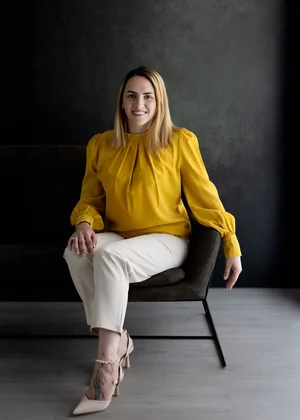
Maria Alla is a Business Coach and founder of The Maria Alla Method™. With 15+ years in accounting and finance, she helps women entrepreneurs break the patterns keeping their income stuck — using real numbers, real strategy, and the kind of honesty most coaches avoid. Her book "Money Feels First" is available in 5 languages.
Ready to stop perfecting and start earning? Join the Money Mindset Academy →